
Resultant force in mechanics | formula, calculation & example in Mechanical Design
If a force acts at an angle from the base, as shown in the diagram, where the horizontal component written as F cosθ and the perpendicular (vertical) component written as F sinθ? Let’s understand this step by step.
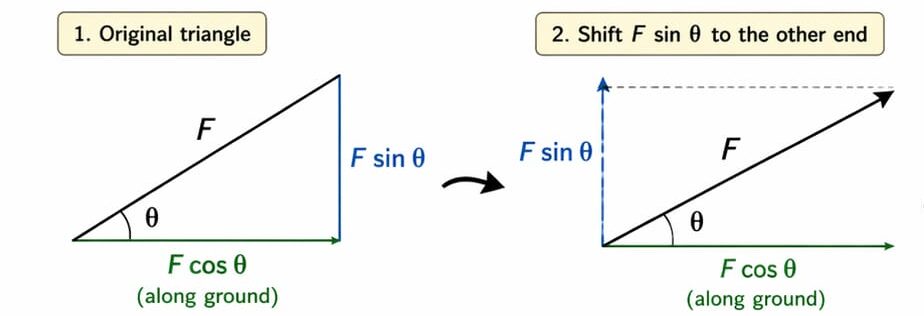
In the image we can see the concept of the F SinΘ and F CosΘ come from the triangle where if we assume the triangle has a A,B & C point from that we are going to find where from the FSinΘ and F CosΘ come from.
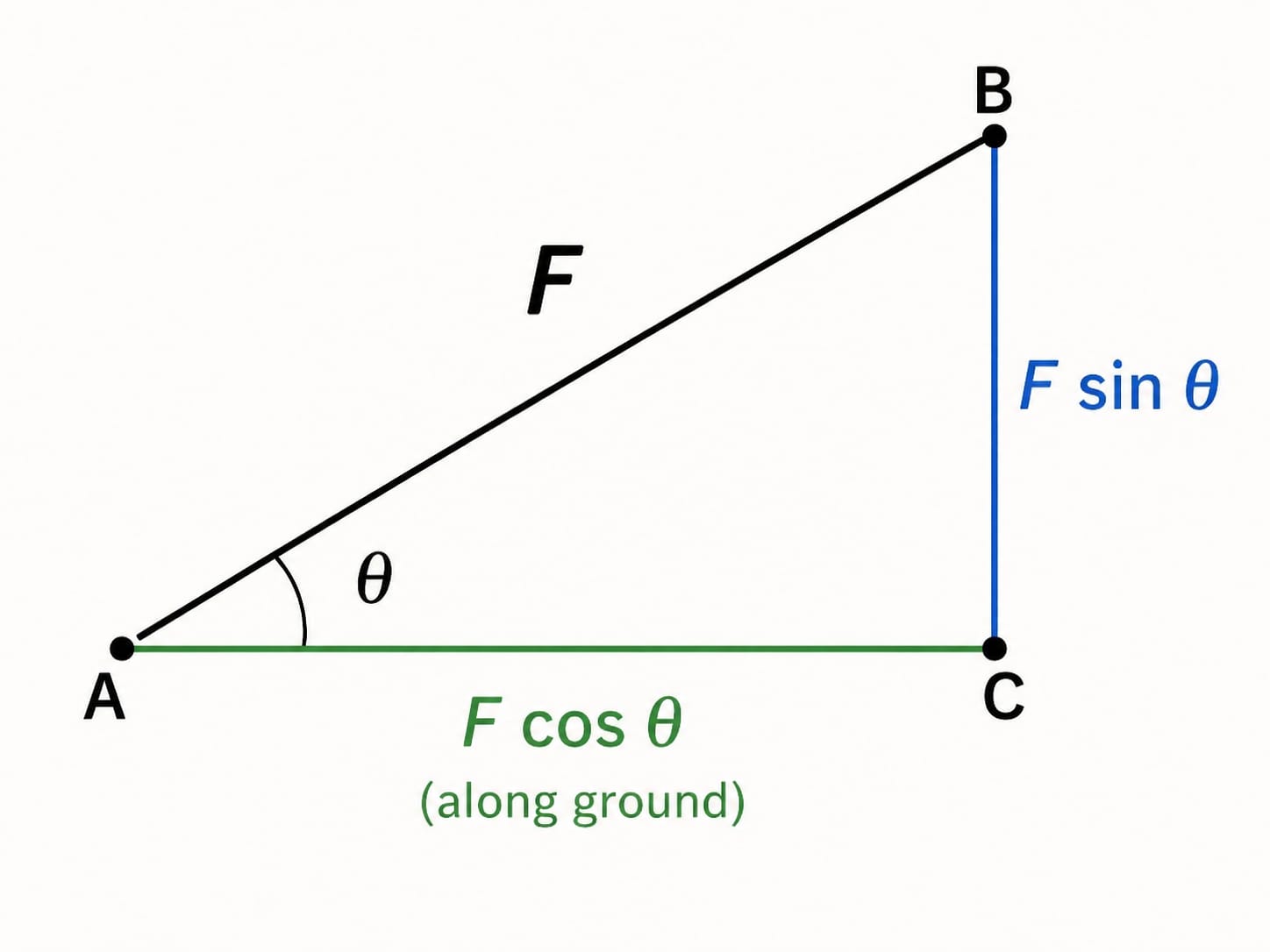
As we know cosΘ = Base / Hypotenuse. In this case CosΘ = AC/AB, if we move the AB to the cos side then it will make AC=AB cosΘ where AB=F, so final ans is AC=F COSΘ. where AC is the base line.
For the SinΘ it will be SinΘ=Perpendular/Hypotenuse. as per the image it will be SinΘ = BC / AB, if we use same process and move the AB to the left side then final ans will be BC = AB SinΘ. Where BC is the perpendular line, AB is the F and final ans will be BC = F SinΘ.
Hope you will understnd.
This method is applicable only to a system of two forces acting at a single point.
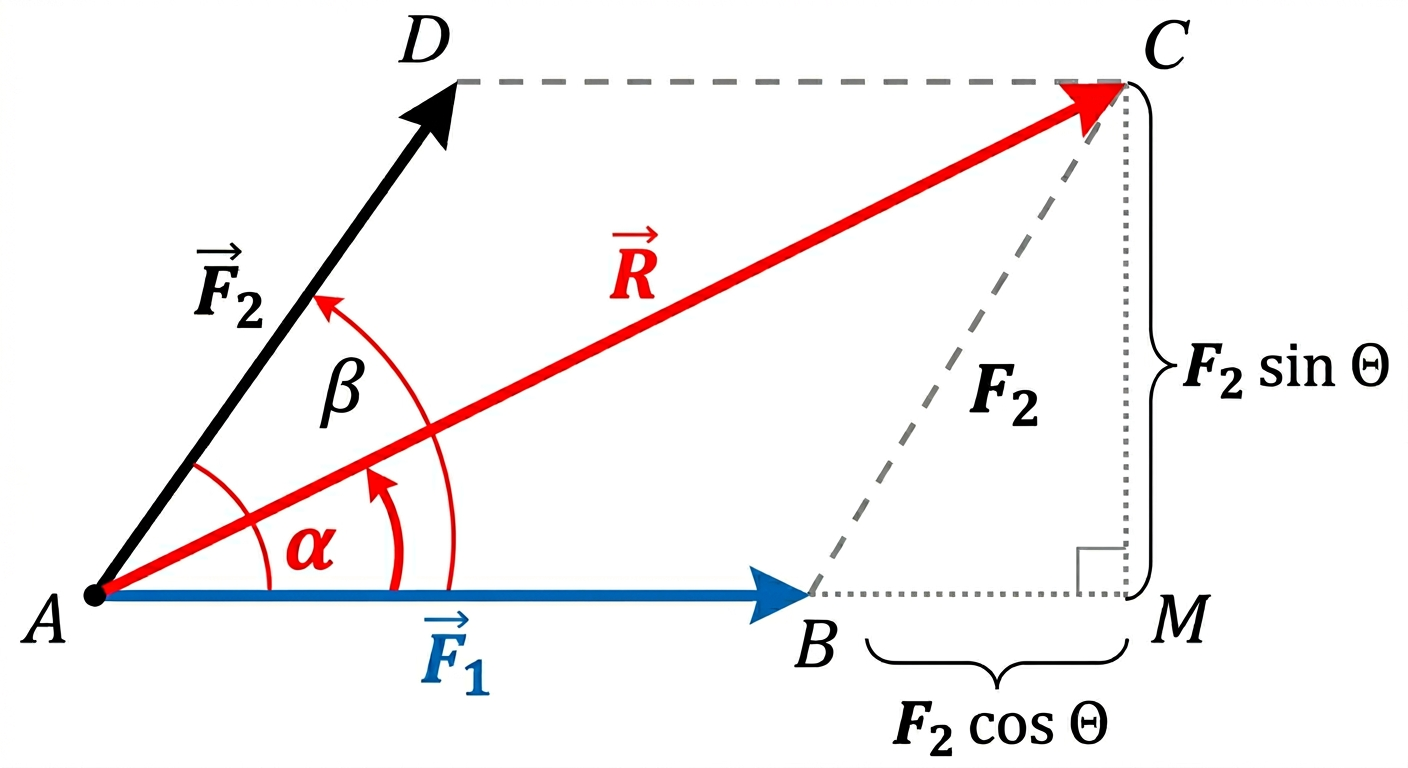 From the diagram we apply the Pythagorean theorem: AC² = CM² + AM², where AC = R (resultant force), CM = F2 sinθ, and AM = F1 + F2 cosθ
Step 1: Substitute values → R² = (F2 sinθ)² + (F1 + F2 cosθ)².
Step 2: Expand the equation → R² = F2² sin²θ + F1² + F2² cos²θ + 2F1F2 cosθ.
Step 3: Use identity sin²θ + cos²θ = 1 → R² = F1² + F2² + 2F1F2 cosθ.
Final result: R = √(F1² + F2² + 2F1F2 cosθ). The resultant force can be found from this equation.
To find the angle of the resultant force, we use:
Step 1: tan α = CM / AC, where CM = F2 sin θ and AC = F1 + F2 cos θ.
Step 2: Substitute values, tan α = (F2 sin θ) / (F1 + F2 cos θ).
Step 3: Therefore, α = tan⁻¹ [(F2 sin θ) / (F1 + F2 cos θ)]. This formula is used to find the angle of the resultant force.
It is also applicable for two forces
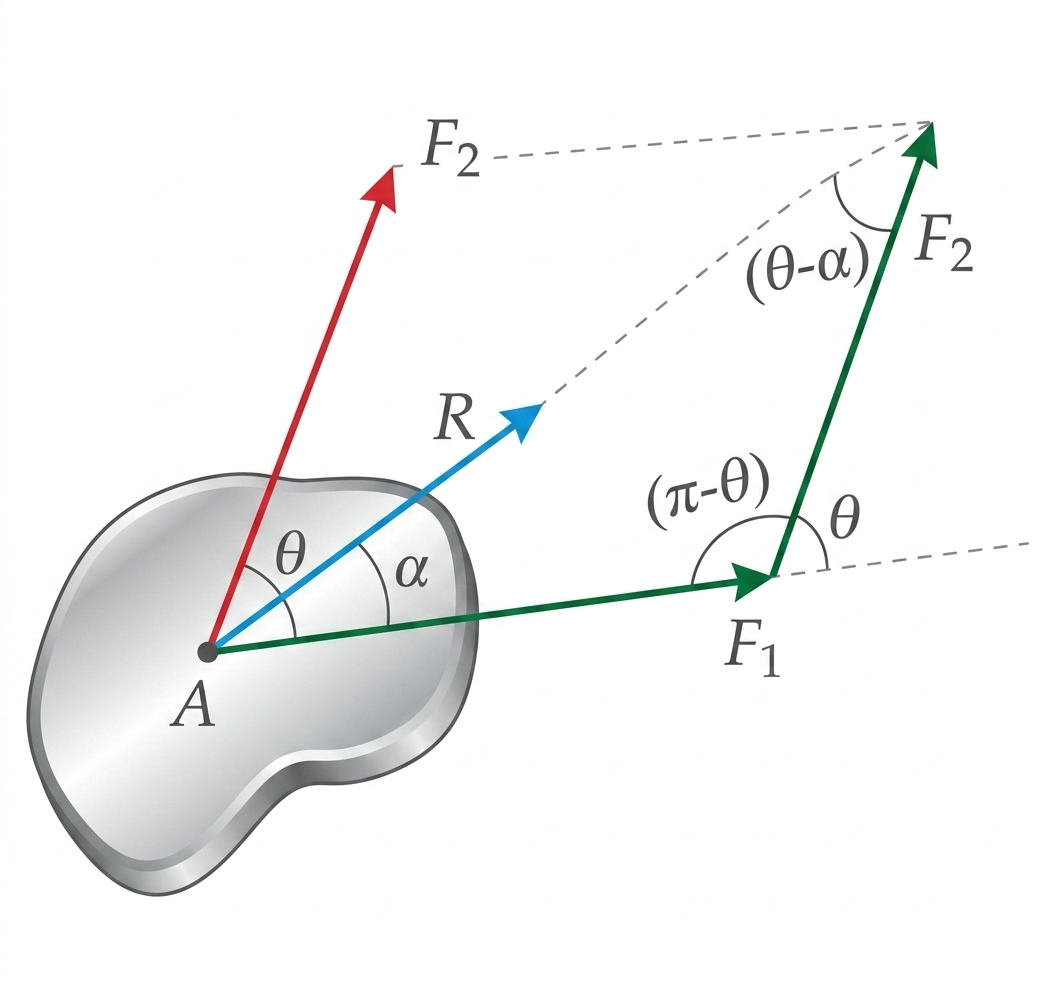
From the diagram, we apply the Triangle Method.
Consider the case where two forces act at a point A. Let F₂ act at an angle Θ with respect to F₁. The resultant force R makes an angle α with F₁.
To analyze this, we shift the force F₂ from point A to the endpoint of F₁ (without changing its magnitude or direction). After shifting, the lines of action of R and F₂ intersect, forming a triangle.
This triangle contains different internal angles, as shown in the figure.
Using this triangle, we can apply the sine rule:
F₁ / sin(Θ − α) = F₂ / sin(α) = R / sin(π − Θ)
From this equation, we can calculate both:
- the magnitude of the resultant force, and
- the angle (direction) of the resultant force.
It is also applicable more than two force
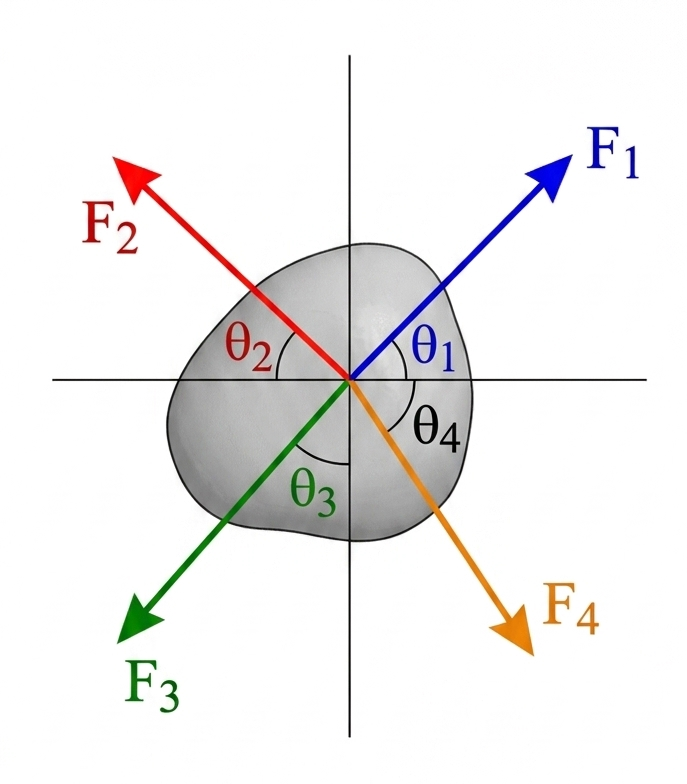
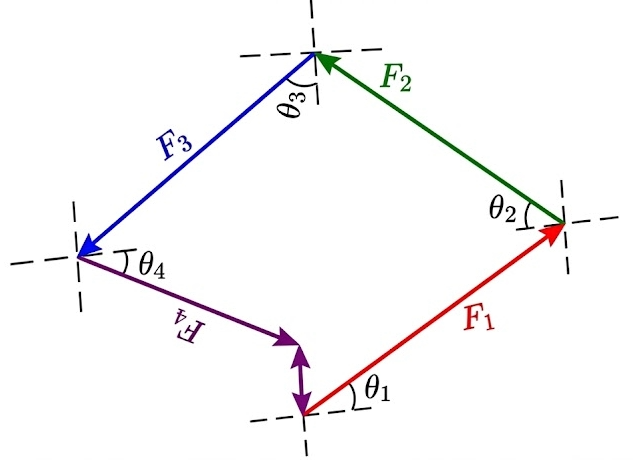
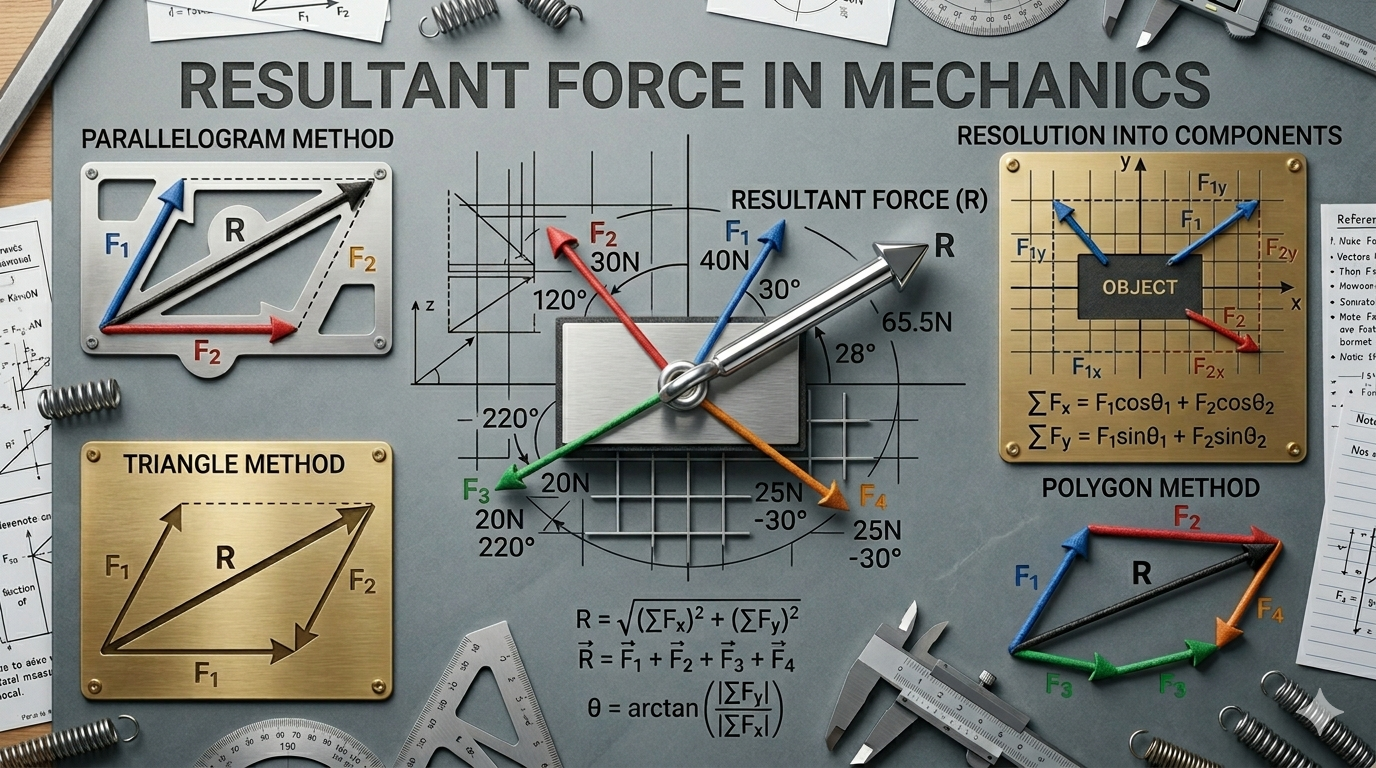
From the diagram, we can see that four forces are acting on a body at different angles.
According to the polygon method, we can find the net (resultant) force graphically.
To find the resultant force using this method, follow these steps:
- Draw the first force vector on an x–y plane with its correct magnitude and direction.
- From the end of the first force, draw the second force vector according to its magnitude and angle.
- Continue this process for all the remaining forces, drawing each new force from the end of the previous one.
This will form a chain of vectors (a polygon).
Finally, draw a line from the starting point of the first force to the endpoint of the last force. This line represents the resultant force in both magnitude and direction.
This method can be applied when multiple forces act on a body.
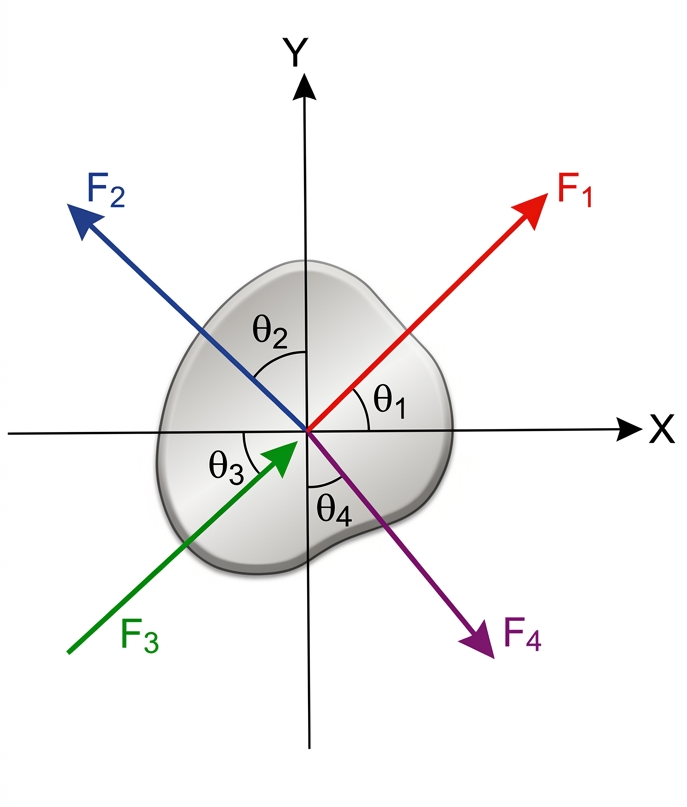
From the diagram, we can see that four forces are acting on the body at different angles and in different directions. The system has two axes: the x-axis and the y-axis. To analyze the forces, we need to resolve each force into its components along these axes.
Since the forces are inclined at various angles, we must first break them into their horizontal (x) and vertical (y) components. This process has already been discussed in the previous section. By doing this, we can represent all the forces in terms of their x and y components, as shown in the diagram.
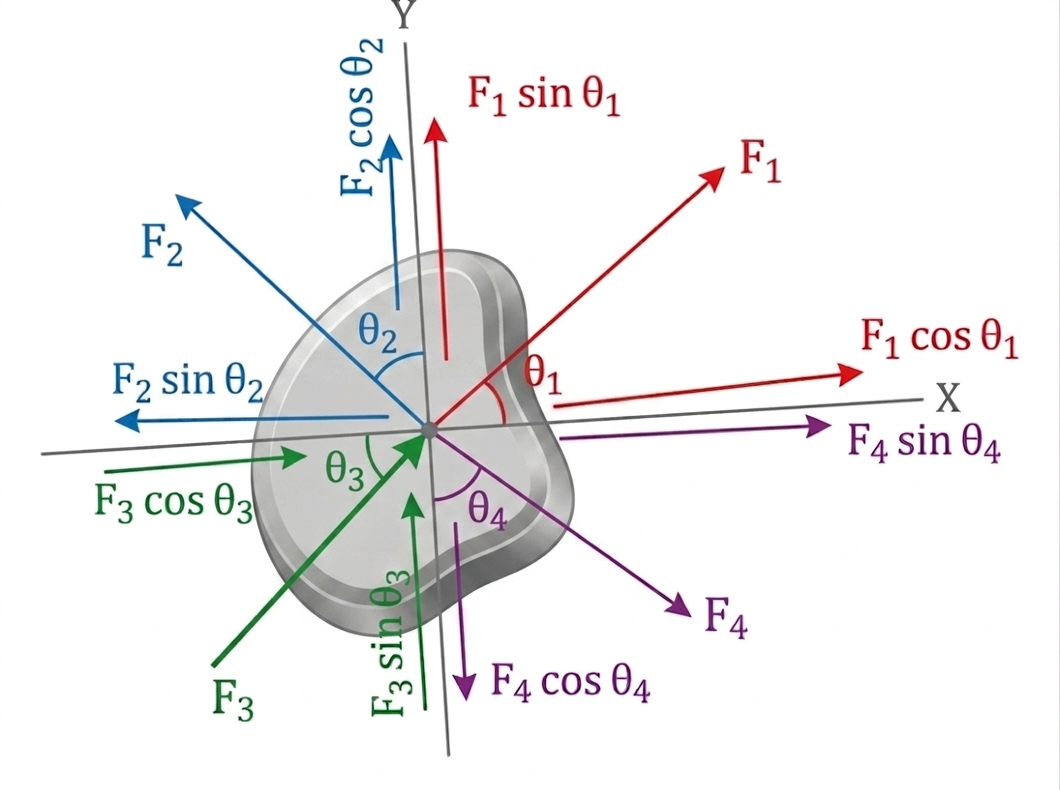
Step 1:
Find the sum of all force components along the x-axis (both positive and negative directions).
From the figure, we get:
ΣFx = F₁cosΘ₁ − F₂sinΘ₂ + F₃cosΘ₃ + F₄sinΘ₄
Step 2:
Find the sum of all force components along the y-axis (both positive and negative directions).
From the figure, we get:
ΣFy = F₁sinΘ₁ + F₂cosΘ₂ + F₃sinΘ₃ − F₄cosΘ₄
Step 3:
Find the resultant force.
For example, suppose the total sum of forces along the x-axis is +10 N, and the total sum along the y-axis is −5 N.

From the figure, we get:
R² = AB² + BC²
So,
R² = (ΣFx)² + (ΣFy)²
R = √[(ΣFx)² + (ΣFy)²]
Using this formula, you can find the magnitude of the resultant force
To find the angle of the resultant force:
tanΘ = BC / AB = ΣFy / ΣFx
Θ = tan⁻¹ |ΣFy / ΣFx|
Using this formula, you can find the direction of the resultant force.
In this formula, we assume that the angle of the resultant force is always taken as a positive value.
It is applicable if the three force acting on a body in some comdition:
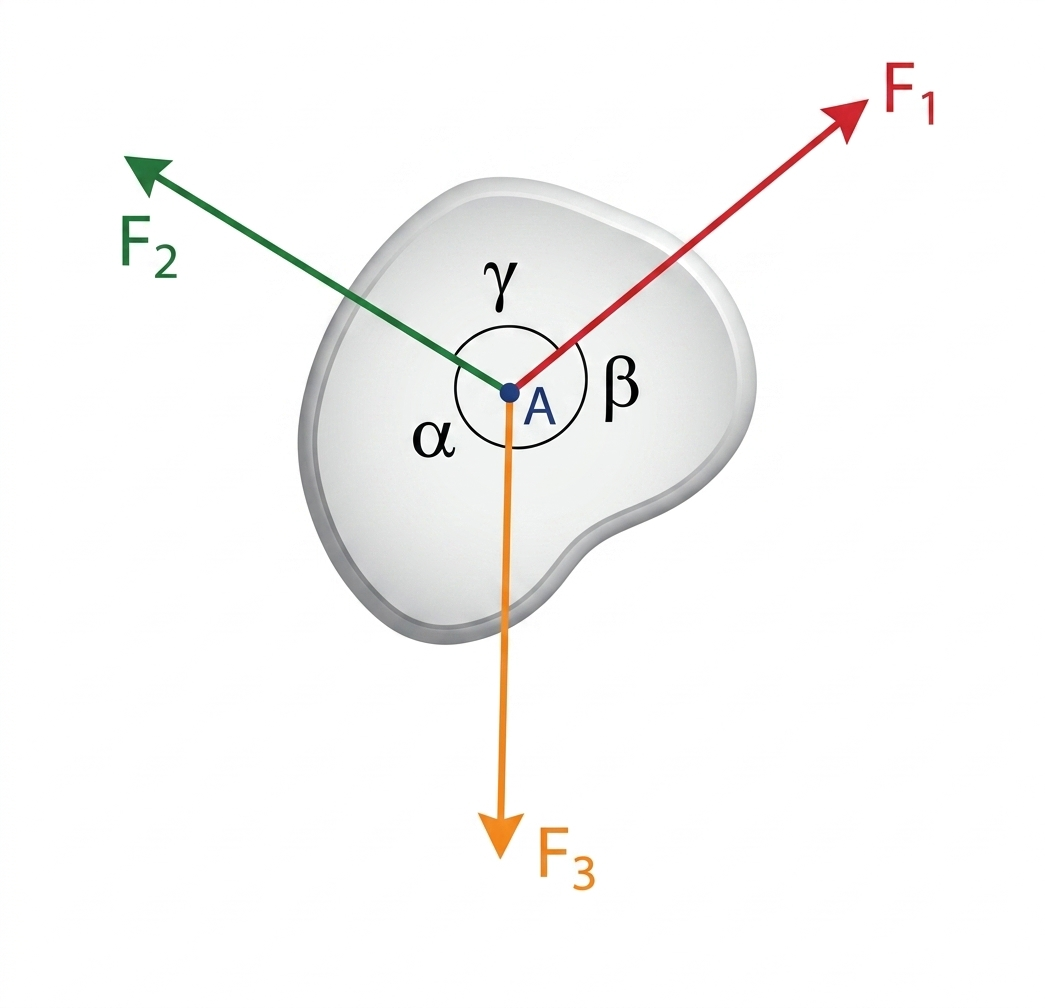
Condition; Radially(inward / outward)
Concurrect ( all the forces acting in a one point, to under stand this visit type of forces page)
Equillibrium condition
All the angle should not be not euals to 180 deg
From the diagram we apply the Pythagorean theorem: